
Sinton Criminal History Checks
A Sinton record check should follow the custodian. Police records use the city’s required online form. The Sinton Municipal Court keeps the city citation, Class C, and capias layer. County booking information comes from the sheriff and jail, while the District Clerk holds filed felony cases. DPS supplies reported statewide conviction and deferred-adjudication information. No single Sinton query combines all five.
- Identify the event, agency, date, location, and the kind of Sinton record needed.
- Use the mandatory Sinton Police public-records web form for a city incident, arrest, crash-information, or body-camera request.
- Check Sinton Municipal Court for a city citation, Class C matter, or warrant-list lead, then confirm current status with the court.
- Contact the San Patricio sheriff for county custody and the proper clerk for a filed county case or certified disposition.
- Use Texas DPS for the distinct statewide public conviction and deferred-adjudication product.
A Sinton warrant list, booking entry, and court judgment are not interchangeable. Use a Sinton report number, citation number, or cause number whenever possible.
Sinton Police Request Form
Sinton requires police records requests through its dedicated web form. That instruction makes the form the first access channel for a Sinton Police report, not a general email to City Hall. The request captures contact details, record type, event facts, and extra information for body-camera video. Digital media is delivered electronically under the posted process.
The official Sinton Police request form supplied the image below. Its detailed fields show that a useful request is tied to an identifiable event rather than a vague name search.
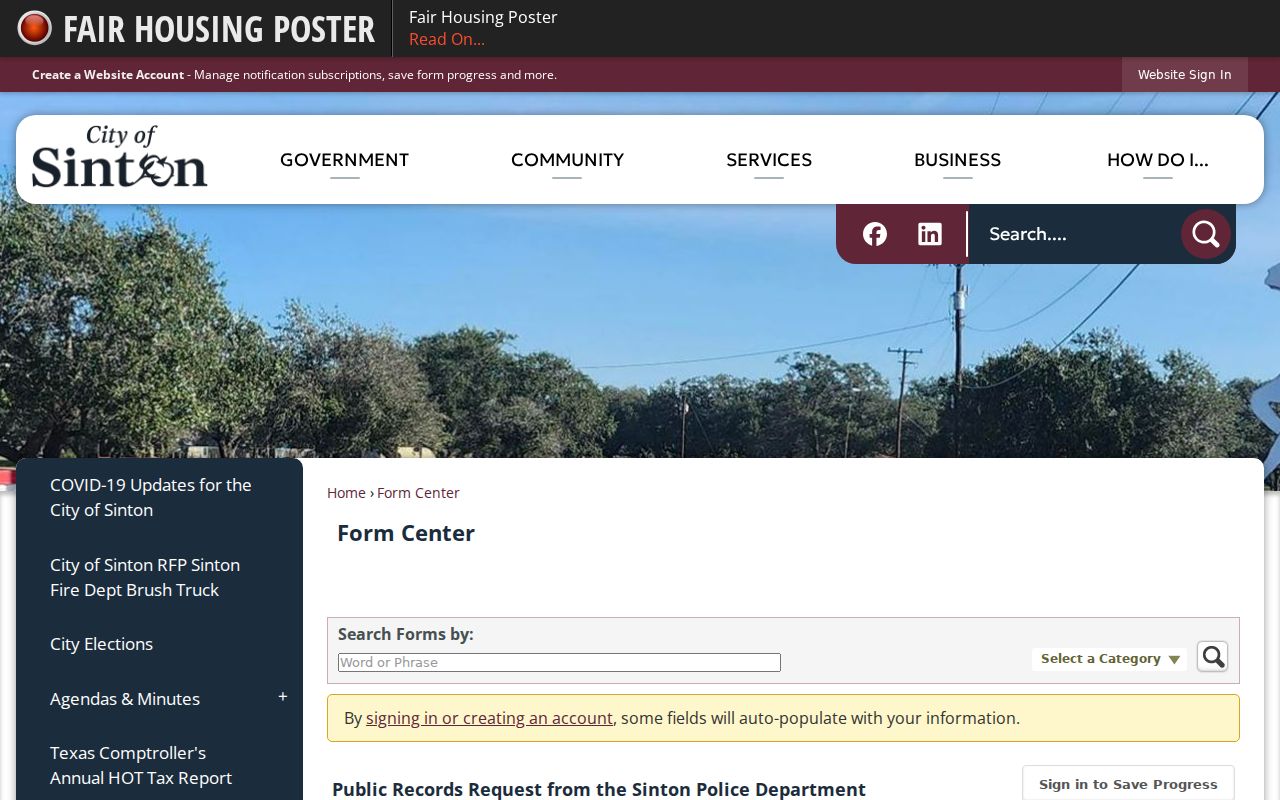
The Sinton form is an access route to existing Sinton police records. It does not create a county booking search or a complete Sinton criminal-history report.
Records at the Sinton Police Department
Sinton Police keeps the reports its officers create. A report can describe the incident, date, location, alleged offense, and police action, subject to lawful redaction. The department’s online form asks the requester to select a record type and identify the event. Those details help Sinton locate a specific file and decide which parts can be released.
Police custody ends where other custodians begin. A person taken to the county jail receives a separate booking record from the sheriff. A prosecutor’s filed charge appears in the proper court file. The final disposition is proved by that court, not by the first police allegation. Keeping those files separate prevents a Sinton incident report from being mistaken for a conviction.
Note: Sinton requires the police form for police records; the City Secretary channel serves other city public information.
Sinton Body Camera Record Fields
Sinton’s form has a special body-camera section because Texas Occupations Code Section 1701.661 requires enough detail to identify the recording. The requester must supply the incident date, approximate time, location, and the name of at least one person involved. Missing the statutory identifiers can defeat the request even when the video exists.
| Form field | Type | How Sinton uses it |
|---|---|---|
| Requester name, phone, email | Contact fields | Required for submission and electronic response |
| Address, city, state, ZIP | Address block | Identifies the requester |
| Organization | Text | Optional |
| Type of record | Selection | Required to route the request |
| Incident identifiers | Text, date, location | Describes the existing Sinton record |
| Body-camera details | Conditional section | Date, approximate time, place, and involved person identify the recording |
| Delivery | Electronic default | Digital media is sent electronically |
These fields are a real access rule, not paperwork for its own sake. A precise Sinton submission is more likely to reach the right recording and avoid delay.
Booking and Arrest Records in Sinton
A Sinton arrest can produce a city report and a county booking within a short span. Sinton Police keeps the report. The San Patricio sheriff and jail at 300 N. Rachal in Sinton maintain the county intake and custody record. The sheriff’s main number is 361-364-9600. No confirmed official county daily booking roster was found, so current custody should be checked by phone or through the sheriff’s official VINELink route.
Booking proves custody, not guilt. Intake data may include the arrest time, agency, alleged charge, bond, hold, and release status. Prosecutors may later file a different charge or decline the case. The county San Patricio arrest channels cover the booking fallback in depth, while the Sinton police form remains the source for the city-created report.
Sinton Municipal Warrant Records
Sinton Municipal Court posts annual warrant-list links, including a 2024 list and older years. These city lists show why a municipal check matters even when a county search returns nothing. A city capias or fine-only matter can remain in Sinton Municipal Court’s records rather than appear in a broad county portal.
The official Sinton Municipal Court page supplied the warrant and court image below. The page is a starting point for a named lead, but a dated list cannot confirm that a warrant is still active or has been cleared.
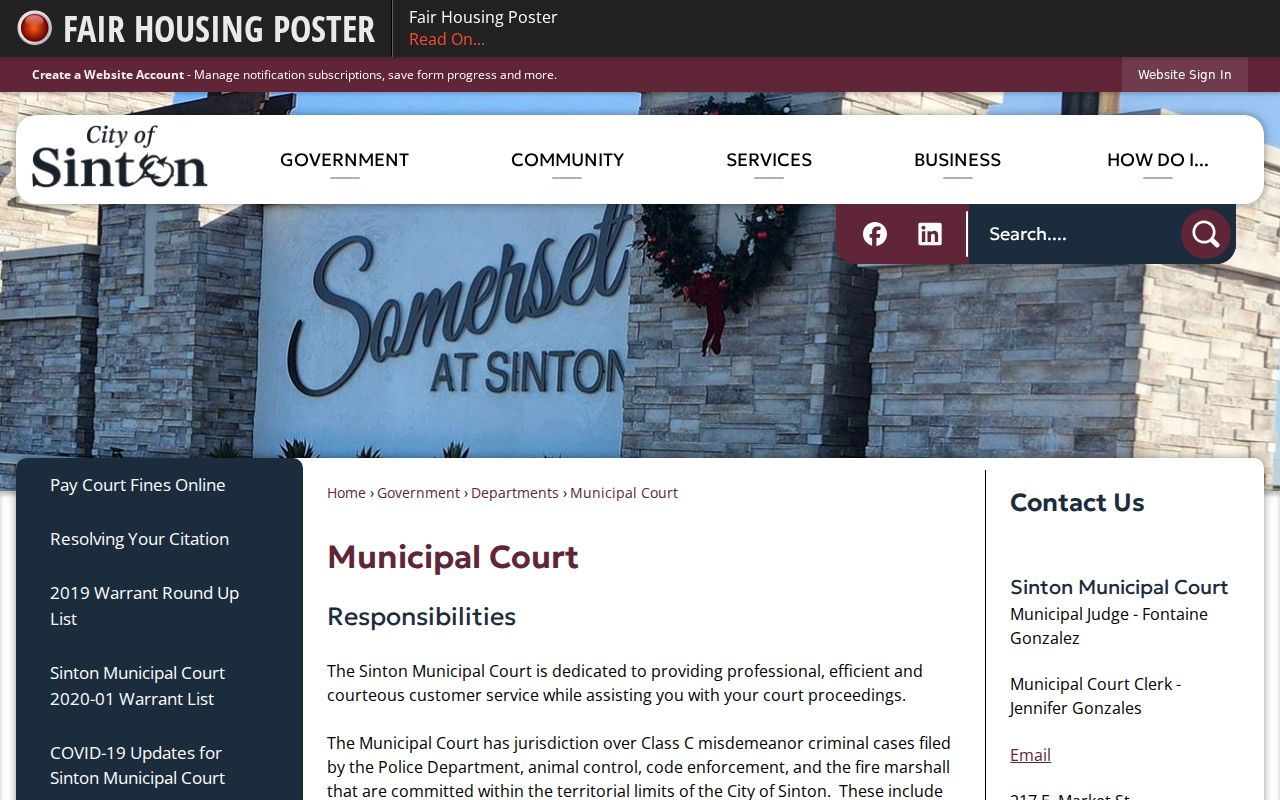
Confirm status directly with the issuing court before acting on an old entry, and obtain court confirmation after any resolution.
When a Sinton name appears, record the year of the list and any citation or case identifier shown. Call the Sinton Municipal Court rather than assuming the entry describes a new arrest. Ask which Sinton court file supports the listing, whether the process is still active, and what official appearance or payment instructions apply. A warrant-list entry is a lead to the issuing court, not a substitute for current court confirmation. It also cannot show whether a separate county booking or felony case followed. Those records stay with the sheriff and the proper county clerk.
The Sinton Municipal Court File
Sinton Municipal Court hears Class C matters filed by police, animal control, code enforcement, and the fire marshal. Its scope includes traffic and parking cases, ordinance violations, public intoxication, theft within Class C limits, drug-paraphernalia possession, and disorderly conduct. These are city cases. A felony does not become a municipal case because the event occurred inside Sinton.
| Court Name | Sinton Municipal Court |
|---|---|
| Case Types Heard | Class C, traffic, parking, ordinance, and other fine-only city matters within its jurisdiction |
| Case Lookup Channel | Municipal Court contact and official annual warrant-list links |
| What the File Shows | City charge, docket activity, court orders, warrant or capias entries, and disposition |
| Copies and Fees | Confirm court-file copy terms with the municipal clerk |
The Sinton municipal file should be read beside, not in place of, any police or county record tied to the same Sinton event.
The filing source can help explain what the city file contains. Police, animal control, code enforcement, and the fire marshal may all start matters within the court’s stated Class C jurisdiction. Review the charging entry and final disposition instead of inferring the result from the department name. If the allegation exceeds municipal authority, ask which county or district clerk received the higher-level filing. This keeps Sinton’s city docket distinct from the nearby courthouse even though both are in the county seat.
Sinton Crash and Police Records
Sinton states that it holds a basic-information report for crashes but does not hold the official crash report filed with the state. That is a rare, useful custody warning. A requester who asks Sinton for “the crash report” without stating which record is wanted may reach the wrong file even though the city has some information about the event.
Use the police form for the basic Sinton report and follow the state route for the official crash document. The same principle applies across criminal records: ask the office for the precise product it owns. A city incident narrative, jail intake, and court disposition may share a date and name yet still be separate government records.
How Sinton Records Reach the County
Sinton is unusual because the city police, county jail, courthouse, and District Clerk channels are all based in the county seat. Physical closeness does not merge their files. Sinton Police retains its report. The sheriff creates the Sinton booking. Prosecutors choose the filed charge, and the correct clerk keeps the Sinton case. Qualifying Class B misdemeanor and more serious Sinton events are then reported through the Texas criminal-history chain.
Record flow: Sinton Police Department › San Patricio County Courts › Texas Department of Public Safety
A new Sinton arrest may appear in police or custody records before any disposition exists. DPS public records focus on reported convictions and deferred adjudications rather than every raw event. The court’s certified disposition remains the best proof of the final result.
Sinton City and County Record Doors
City Hall is at 301 E. Market, while the San Patricio County Courthouse is at 400 W. Sinton Street. The Sinton City Secretary public-information channel handles non-police Sinton records at 361-364-2381, fax 361-364-3781, Monday through Friday from 8:00 a.m. to 4:30 p.m. The courthouse and its clerk channels handle county judicial work instead.
| Sinton record | First door | Reason |
|---|---|---|
| Police incident, arrest, or body-camera file | Sinton police web form | The city department created it |
| Other city public information | City Secretary | The city posts this separate channel |
| Class C citation or municipal capias | Sinton Municipal Court | The city court owns its docket |
| County booking or felony case | Sheriff or proper county clerk | The record sits outside city custody |
This split is the core of a sound Sinton record check. The address on a Sinton record does not tell the whole custodial story. The city’s railroad-era role as county seat helps explain why so many Sinton and county counters now sit near one another. Yet the record lineage is older than the current web forms: San Patricio District Court minutes survive on Texas State Library microfilm from 1848. A historic Sinton-related case that does not appear in a modern search may therefore call for a clerk inquiry and, for older material, the state library’s local-record inventory. No source promises that those early records are digitized. Modern access still follows custody. Sinton Police answers for its own reports, the municipal clerk answers for city cases, and the county clerk or District Clerk answers for its court files.
Sinton Record Copies and Delivery
Sinton’s posted city policy provides 40 pages or fewer without a copy charge. Pages above that level cost $0.10 each, and Sinton issues an itemized estimate when charges exceed $40. These Sinton terms concern city public-information copies. They should not be carried over to a court clerk or county office, which can have a different lawfully published schedule.
Electronic delivery is the default for digital media submitted through the Sinton form. A requester should still describe the preferred record and medium clearly. If a request covers a large set, narrowing the dates, event, and record type can reduce review and copying work without sacrificing the actual file needed.
Note: Sinton’s posted copy terms apply to city records, not automatically to municipal court, county clerk, or sheriff products.
Sinton Record Access Rules
Sinton police and city administrative records are requested under the Texas Public Information Act. The law allows access to public information while protecting defined categories. Active investigative material, juvenile records, protected victim data, confidential identifiers, and some media may be withheld or redacted. Municipal and county adjudicative case files are requested from the clerk under the rules and law governing court records.
Key Statutes:
Texas Government Code Chapter 552 governs city public-information requests and exceptions.
Texas Government Code Chapter 411 controls criminal-history dissemination through the state system.
Texas Code of Criminal Procedure Chapter 66 governs reporting of qualifying criminal justice events.
Texas Occupations Code Section 1701.661 sets identifying requirements for body-camera requests.
A released Sinton report still reflects the record type and stage that created it. For the outcome, consult the issuing court. For custody, consult the sheriff. For state-reported history, use DPS.