
Portland Criminal History Checks
A Portland record check works best when it starts with the event, not with a broad name query. Portland has two distinct doors. The Portland Police Department keeps reports for events its officers investigated. Portland Municipal Court keeps the citation and Class C case record within its jurisdiction. Neither Portland source is a full criminal history. A booking may sit with San Patricio County, and a filed Portland felony belongs with the District Clerk in Sinton. Texas DPS supplies the reported statewide conviction and deferred-adjudication layer.
- Identify whether Portland police, another agency, or a court created the record.
- Use the official Portland police records channel for a city incident or arrest report, giving the report number when known.
- Search Portland Municipal Court by legal name or by citation or violation number for a city-level matter.
- Check the San Patricio sheriff and the right county clerk when the event led to booking or a higher-level charge.
- Use Texas DPS for the separate statewide public conviction and deferred-adjudication search.
Each step answers a narrower question. A matching name is not proof of identity, and an arrest label is not the final filed charge. When the result will be used to understand how a case ended, obtain the disposition from the court that entered it.
Portland Police Report Requests
The Portland Police records page is the official starting point for reports of events investigated by Portland officers. A focused Portland request should identify the event or report number, the date, the location, the people named in the report, and the record sought. Those facts help Portland staff distinguish one Portland incident from another without asking the department to create a new compilation.
Agency ownership matters. A Portland mailing address does not prove that Portland police handled the call. The city lies in the coastal Corpus Christi metro area, where jurisdiction can be easy to assume incorrectly. Confirm the responding agency before filing. If another department made the report, Portland is not the right custodian even when the event happened near the city. This one check can save a long detour.
Records at the Portland Police Department
Portland police records describe what Portland officers received, observed, and investigated. Depending on the event and lawful redactions, a Portland report may carry an incident number, date and place, alleged offense, involved people, officer information, and a narrative. The Portland police file is not the same as the jail intake record. It also does not replace the Portland municipal or county court file after a charge is filed.
Texas public-information rules may limit active investigative detail, confidential juvenile material, protected victim information, and personal identifiers. Basic arrest and offense information has a different status from the full investigative file. Ask for an existing record in clear terms. If Portland withholds or redacts material, the response should be read in light of the cited law rather than treated as proof that no event occurred.
Note: Portland police records should be requested from Portland, while a county booking or court disposition must be obtained from its own custodian.
Portland Records and Coastal Jurisdiction
Portland is the largest incorporated place profiled in San Patricio County, yet local geography can split one Portland episode across several offices. The city department may keep the first report. San Patricio County may hold the booking. A court in Sinton may keep the felony case. DPS can later receive the arrest, prosecution, and disposition events that law requires agencies to report.
That split explains why a single Portland name search can look incomplete. The answer may not be missing. It may be held at a different level. First confirm the agency, then the type of charge, then the court. County and state sources should remain a follow-up step rather than crowding out the Portland-specific record doors.
Booking and Arrest Records in Portland
A Portland arrest creates more than one paper trail. Portland police create the arrest or offense report. Longer custody is routed into the San Patricio County jail system, where booking adds intake identifiers, charges, bond or hold information, and release status. The county does not publish a confirmed official daily booking roster. The official fallback is to call the sheriff or follow the sheriff’s VINELink route for custody information.
The Portland report and county booking entry serve different purposes. An intake charge shows the allegation recorded at admission, not guilt. A prosecutor may file a different Portland charge, decline a case, or take later action. Readers tracing the next stage can use the county arrest search channels for the full official fallback chain without turning a Portland city record check into a county-wide search.
When a Portland Citation Stays Local
A Portland municipal result may appear even when no county case does. That is often a matter of Portland jurisdiction, not a data error. Municipal courts handle fine-only Class C, traffic, and ordinance matters within their authority. The Portland court result can therefore be the primary case record for a Portland citation. Felony and Class A or B misdemeanor files follow other routes.
Read the municipal result for its own scope. A violation or citation number can tie the search to a specific city matter. If the record suggests a warrant, capias, payment issue, or open setting, confirm current status with the municipal court rather than relying on a stale screen. If the event instead moved to county prosecution, the clerk holding that filed case is the source for its disposition.
The Portland Municipal Court File
Portland provides an official Municipal Online Services interface with a “Search violations” function. It supports a name mode and an alternate citation or violation number route. The court channel is useful for a known Portland citation, but it is not a full Texas or San Patricio criminal history. It covers the municipal slice.
The official Portland Municipal Court search supplied the interface image below. Its separate name and violation-number paths show why a direct identifier is stronger than a broad name alone.
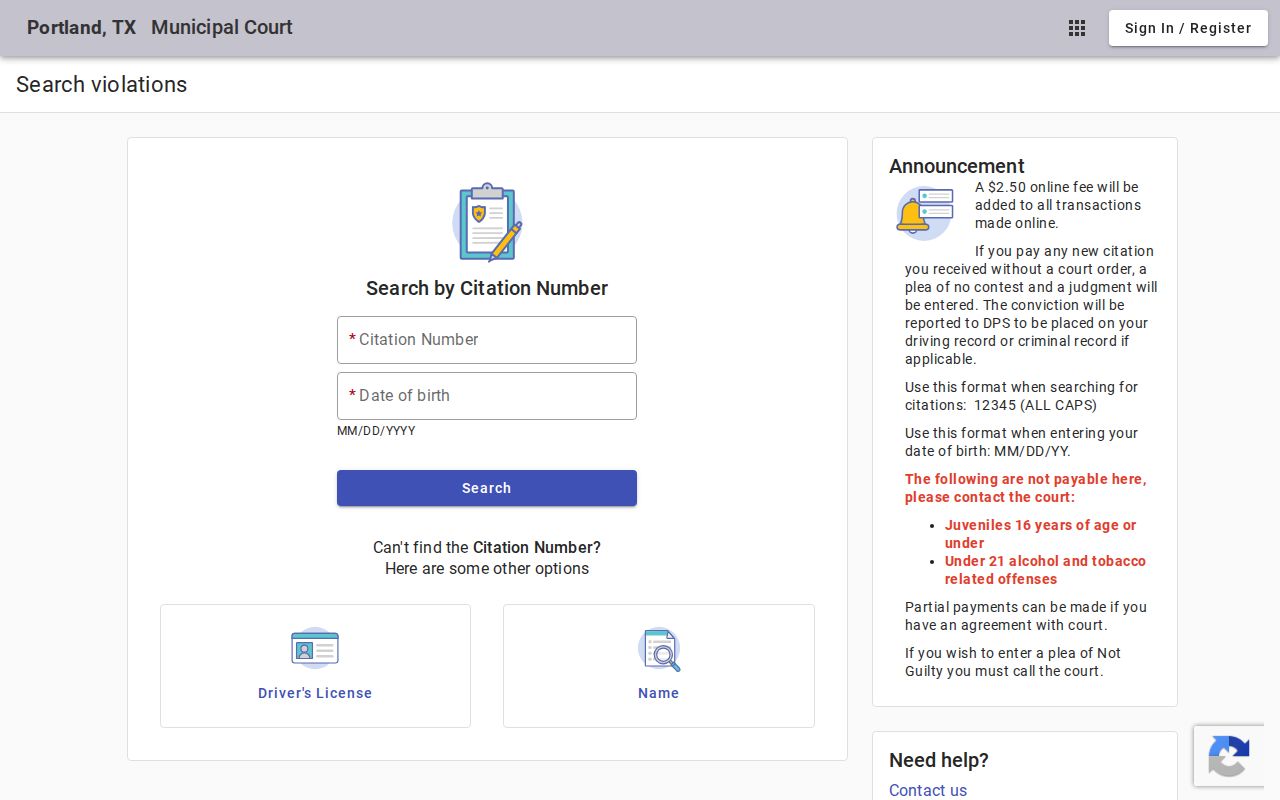
The Portland screen is a city court access point, not a promise that every Portland arrest or Portland-related county charge will appear there.
| Court Name | Portland Municipal Court |
|---|---|
| Case Types Heard | City Class C, traffic, citation, and ordinance matters within municipal jurisdiction |
| Case Lookup Channel | Official online search by name or by citation or violation number |
| What the Search Shows | Municipal violations tied to the search terms, subject to identity and status confirmation |
| Copies and Fees | No municipal copy fee was published in the research; confirm requests with the court |
Portland Court Search Limits
A court-payment or violation portal should not be read as a complete Portland criminal record. It may help locate a municipal matter, but it does not merge the police narrative, county jail booking, county criminal case, or DPS history. It also cannot resolve two people with similar names as reliably as a direct citation number can.
Use the legal name when the Portland identifier is unknown, review the returned details carefully, and confirm current status with the court. For a certified disposition in a county case, order the record from the issuing clerk. The broader San Patricio court case lookup explains why Texas has no single complete person-based trial-court index and why the local clerk remains authoritative.
How Portland Records Reach the County
A Portland incident does not move as one file. The police report remains with the city. If officers place a person in county custody, the sheriff creates a separate booking record. Prosecutors decide what charge to pursue, and the correct clerk keeps the filed court case. For a Class B misdemeanor or more serious event, agencies report fingerprint-linked arrest, prosecution, and disposition data into the Texas Computerized Criminal History system.
Record flow: Portland Police Department › San Patricio County Courts › Texas Department of Public Safety
Timing and scope differ at each point. The newest detail may still be at Portland police or the jail, while a final outcome belongs in the court file. DPS public results generally focus on reported convictions and deferred adjudications. They do not act as an archive of every Portland incident.
Reading Portland Class C Records
Several terms help place a Portland municipal result. A citation starts the local matter. A docket is the chronological list of settings and events. A disposition tells how the charge ended. A capias is a court order directing arrest, sometimes tied to a missed step or enforcement after judgment. None of those terms, standing alone, proves the full history of an event.
- Citation
- The city charging document or notice tied to a municipal allegation.
- Docket
- The court’s dated sequence of settings, entries, and actions.
- Disposition
- The result of the charge, such as a judgment or dismissal.
- Capias
- A court order directing arrest in the circumstances shown by the municipal file.
When a Portland result is unclear, use the cause, citation, or violation number in the next contact. That identifier is more useful than a broad question about someone’s entire history.
Portland City and County Records
The key comparison is custodial. Portland police hold the event report. Portland Municipal Court holds its city case. The sheriff holds county booking information, while a district or county clerk holds a higher-level prosecution. DPS holds the reported statewide slice. These channels overlap in names and dates, but they do not duplicate one another.
For one Portland event, write down the identifier from each layer instead of expecting one number to work everywhere. The police report number points back to the city investigation. A booking number identifies county intake. A municipal citation or county cause number leads to the court record. When dates or charge labels differ, the final signed court disposition controls the result of the filed case. This method also helps prevent the San Patricio County Clerk’s official property-record portal from being mistaken for a Portland criminal docket. That portal records a different class of documents and cannot rule a criminal case in or out.
| Portland question | Best first source | What it establishes |
|---|---|---|
| What did city officers report? | Portland Police records | The city-created incident or arrest report |
| What happened to a city citation? | Portland Municipal Court | The municipal docket and result |
| Was the person booked? | San Patricio sheriff or VINELink | County custody information |
| How did a higher charge end? | Issuing county clerk | The filed case and certified disposition |
This route keeps a Portland record search at the right altitude while still showing where Portland’s authority ends.
Portland’s coastal metro setting makes the agency check especially useful. Confirm the officer or department named on the document before sending a request. If the event crossed a city or county line, ask each confirmed custodian only for the file it created.
Portland Record Access Rules
Portland police administrative and law-enforcement records can be requested under the Texas Public Information Act, subject to statutory exceptions. Court case records follow the law and rules that apply to adjudicative files and are obtained from the clerk. A city may redact protected identifiers, juvenile information, certain victim data, and investigative content whose release would interfere with an active matter. A precise request for an existing record gives Portland the best chance to locate and review it.
Key Statutes:
Texas Government Code Chapter 552 provides the public-information request route and its exceptions.
Texas Government Code Chapter 411 controls criminal-history dissemination and access to the DPS-held record.
Texas Code of Criminal Procedure Chapter 66 governs reporting of qualifying arrest, prosecution, and disposition events.
Access does not make every field public. It also does not turn a Portland report into a conviction record. Verify the meaning and final status with the office that created or adjudicated the record.