
San Patricio County Sex Offender Checks
The Texas Department of Public Safety administers the Texas Public Sex Offender Registry under Code of Criminal Procedure Chapter 62. The statewide portal is the broad public search for San Patricio County. It supports a person-based query as well as place-based searches, which are useful when the reader knows an address, city, ZIP code, or county but not a name. A profile may identify the registering agency, so the next question can go to the office that maintains the local file.
There is no confirmed separate San Patricio County registry map or sheriff-app alert tool in the official sources reviewed. For unincorporated addresses, call the sheriff before visiting because appointment hours and registration fees were not posted. For a city address, contact that city's law-enforcement authority. A DPS result is the public record layer. The local agency keeps the registration and performs the verification or notice duties assigned by law.
San Patricio County Registry Authority
Responsibility turns on where the registrant lives. A person inside a city reports to that city's local law-enforcement authority. A person outside a city reports to the San Patricio County Sheriff's Office at 300 N. Rachal in Sinton, 361-364-9600. Local authorities maintain registrations, carry out required checks and notices, and transmit registry data to DPS. This division explains why a profile may name a city police department rather than the sheriff.
Use the listed registering agency first. The San Patricio County sheriff page provides the county contact. City residents can start with the official Portland Police, Ingleside Police, or Sinton Police request channel when one of those agencies appears on a profile.
The official DPS registration-program page describes the state and local roles behind San Patricio County registry records.
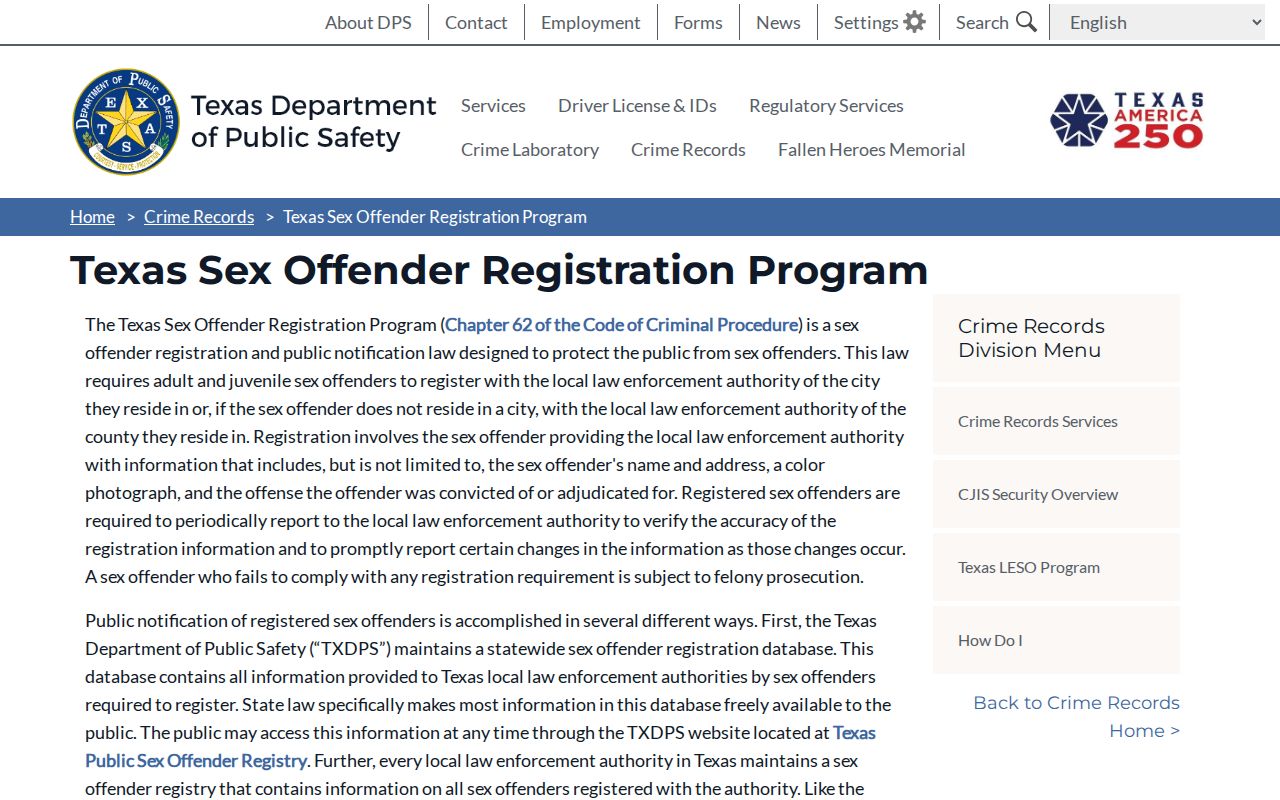
This source helps separate the public DPS search from the local office that verifies and sends each registration record.
Texas Public Sex Offender Registry Searches
The Texas Public Sex Offender Registry is free and covers public Texas registration records. Start with the narrowest reliable fact. A county filter can show San Patricio County results, while address and map tools support a location-based review. Name searches work best when first and last names can be paired. Exact controls can change, so follow the options displayed on the live portal.
- Open the DPS registry and read the current conditions of use before searching.
- Choose a name search or a place search by address, city, county, ZIP code, radius, or map as the live screen allows.
- Select San Patricio County or enter the known local place, then compare result details carefully rather than relying on a name alone.
- Open the full public profile, note the registering agency and status details, and contact that authority when a fact needs confirmation.
| Field or control | Type | Required | Use |
|---|---|---|---|
| Last Name | Text | Conditional | Starts a name-mode search |
| First Name | Text | Optional or conditional | Narrows the name match |
| Address | Text | Conditional | Starts a location or radius search |
| City | Text or dropdown | Conditional | Limits results to a locality |
| County | Dropdown | Optional | Select San Patricio |
| ZIP Code | Text | Optional | Narrows a location |
| Radius | Dropdown | Address mode | Use the exact live options shown |
| Map Search | Tab or control | No | Opens a geographic search |
| Search / Clear | Buttons | Search is required | Runs or resets the selected mode |
The official registry image shows the public search entry point without centering a private individual's record.
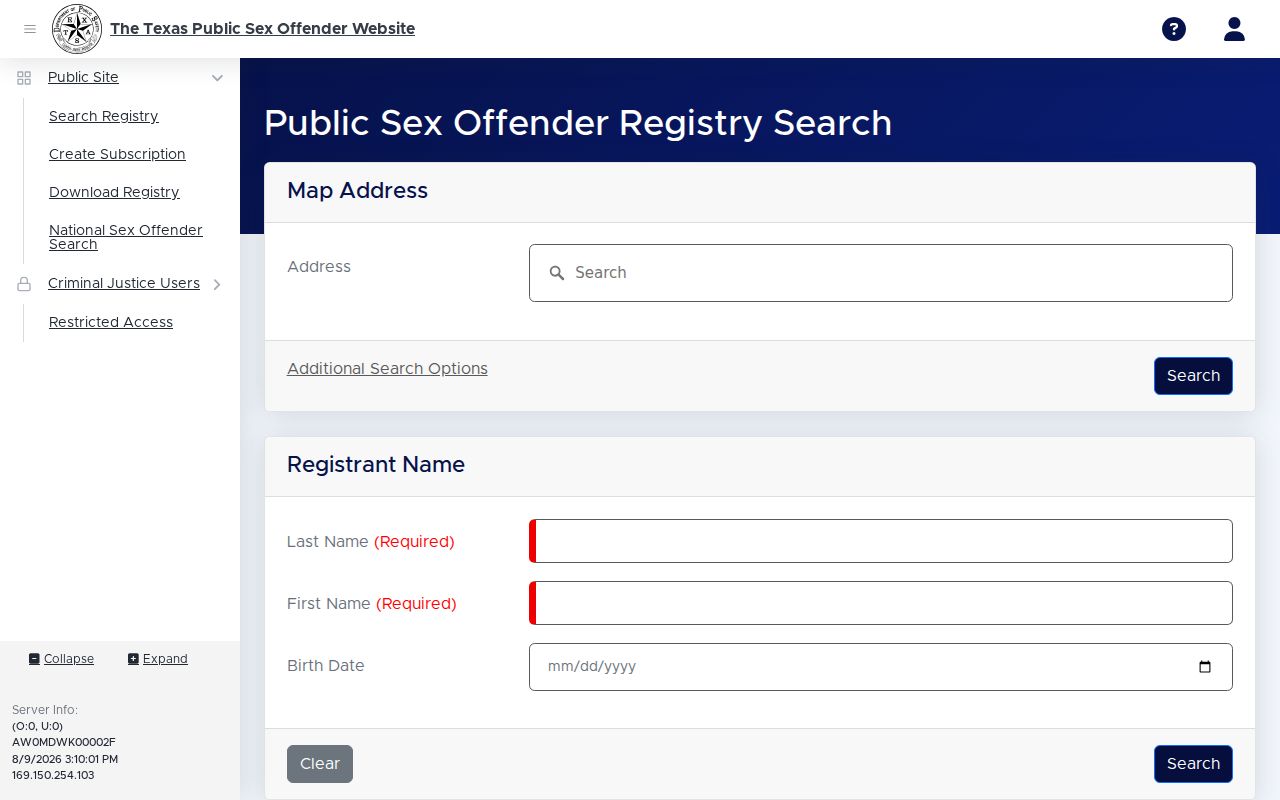
Use the live fields shown there, then verify the profile through its listed San Patricio County or city registering agency.
San Patricio County Registry Search Layers
The DPS registry is the official Texas detail source. The National Sex Offender Public Website, operated by the U.S. Department of Justice, searches participating jurisdictions across state lines. NSOPW is useful when the reader is unsure whether an address or record lies in Texas, or when a safety review extends beyond San Patricio County. Its result should route the reader back to the participating state or local registry for the source profile.
The official NSOPW landing page shows the cross-state layer available alongside a San Patricio County registry lookup.
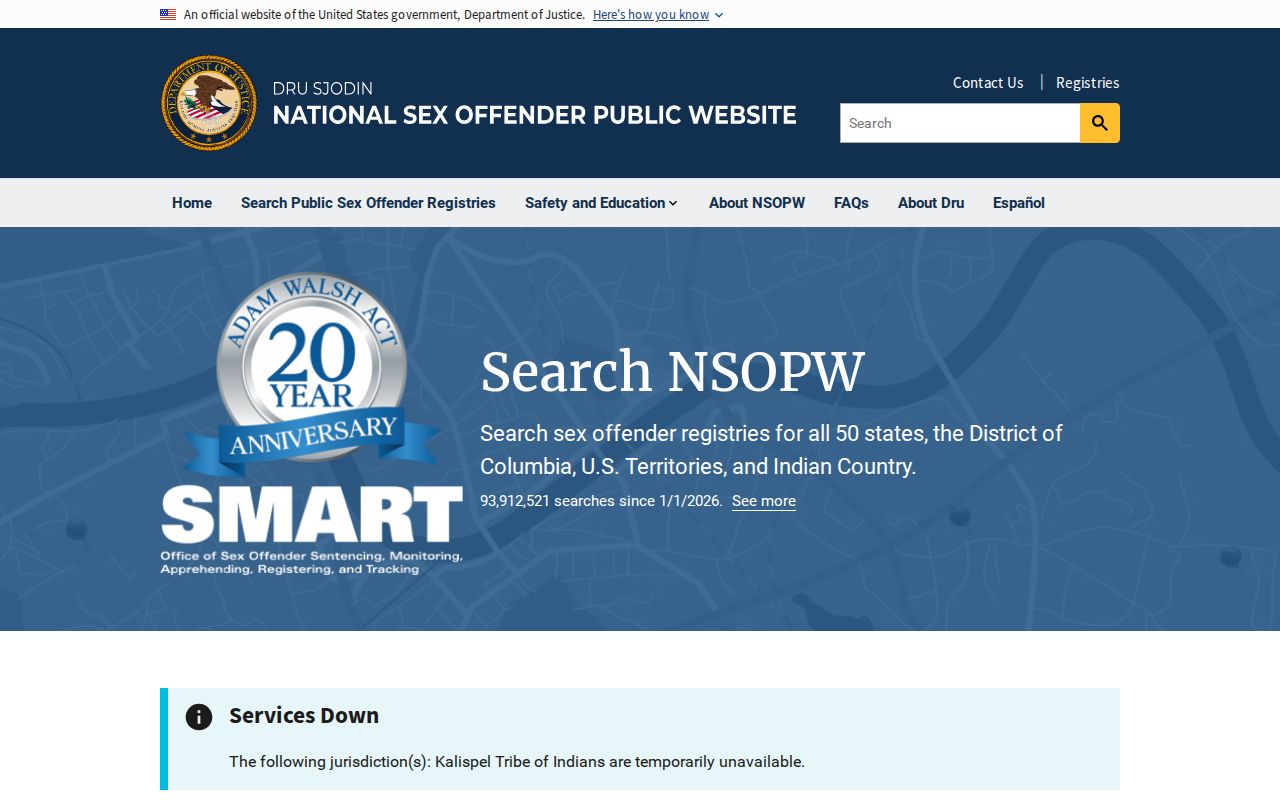
This national search broadens the geographic sweep, but DPS and the listed local authority remain the sources for Texas registration detail.
DPS also supports public subscriptions or notifications through a Crime Records Division public account. The county research did not confirm a sheriff mobile app with its own registry alert feature. Do not expect an app-only San Patricio County map or notification tool.
Registry Profiles: What They Show
A public San Patricio County registry profile is a selected view of a larger registration file. DPS may display identity and physical details, the public address or geographic description, the registering agency, reportable offense, conviction and registration facts, compliance details, and certain vehicle or identifying-mark data. The exact fields depend on what was collected and what the current public interface displays.
| Name and aliases | Public identity names used to distinguish the listed person. |
|---|---|
| Photo and description | Photograph plus public physical traits such as sex, race, height, weight, hair, and eyes. |
| Address or location | Public residence address or geographic description as allowed by Chapter 62. |
| Registering agency | The San Patricio County sheriff or city authority responsible for the local file. |
| Offense and conviction | Reportable offense, statute, conviction date, punishment, and related public facts. |
| Registration details | Reported status, compliance information, and supervision or release data when displayed. |
| Other public details | Vehicles and scars, marks, or tattoos may appear when collected and published. |
Note: A registry listing records a legal registration duty and reported status; it does not authorize contact, threats, or confrontation.
San Patricio County Registry Privacy Limits
Public does not mean complete. DPS collects some facts that it does not publish, including Social Security and driver's-license numbers, telephone numbers, online identifiers, employer contact information, extra DPS-only material, and anything that identifies a victim. Juvenile registration can also be ordered nonpublic. The absence of one of these fields from the public screen is a privacy rule, not proof that the local authority failed to gather it.
Chapter 62 makes most registration information public while preserving specified identifiers and victim data. That boundary also affects records requests. A request to the San Patricio County sheriff or a city department cannot turn confidential registration material into public data. Use the public profile for awareness, and direct a suspected compliance issue to law enforcement rather than trying to obtain protected facts.
Registration Levels and Duties in Texas
Texas registration is driven by the offense, statute, dates, and case facts. The public portal does not reduce every San Patricio County record to a simple federal Tier I, II, or III screen. Chapter 62 assigns lifetime registration to specified serious or reportable circumstances and a post-discharge period to others. Ten years is common for applicable adult duties, but no duration should be predicted without checking the exact offense, conviction date, and sentence discharge.
| Texas category | Public or notice effect | Duration rule |
|---|---|---|
| Chapter 62 public registrant | Most statutory registration fields are public | Offense and date specific; a post-discharge term or lifetime |
| High-risk or civilly committed sexually violent predator | DPS English and Spanish postcard notice to the immediate community | Verify the exact lifetime-category facts |
| Juvenile registration ordered nonpublic | Excluded from the public portal | Controlled by the juvenile order and statute |
| Protected identifiers and victim data | Withheld even when the profile is public | Remain protected |
Texas also lacks one statewide adult residence-distance rule that can be stated as a single number. City ordinances, supervision terms, and civil-commitment rules can differ. Confirm the rule with the relevant city or county office and supervising authority.
San Patricio County Registry Duration Checks
A release date, supervision date, or offense label viewed alone may not answer how long a San Patricio County duty lasts. Duration can turn on the statute that applied, the exact reportable offense, the conviction date, sentence discharge, and whether another special category controls. Juvenile duties follow their own statutory and court-order path. Federal SORNA labels should not be pasted onto a Texas profile as if the systems were identical.
For a duration question, read the profile and case disposition together. Then ask the registering authority or qualified counsel to apply the current Chapter 62 provision to those facts. This avoids a false promise based on a broad label. It also helps explain why two records that look alike on a result list may carry different duties or notice rules.
Report San Patricio County Registry Concerns
If a San Patricio County address or compliance detail appears wrong, note the profile's listed registering agency. Send the concern to that agency or local law enforcement. Unincorporated-address concerns go to the sheriff at 361-364-9600. City matters go to the appropriate city authority. Give the public profile reference and the observed issue without confronting the registrant. Emergencies go to 911.
Community notice can occur through the DPS database, local registries, lawful publication, required school notice, and English or Spanish DPS postcards for high-risk or civilly committed sexually violent predator moves. A public account may also support subscription notices. None of these channels replaces direct agency reporting when the concern is suspected noncompliance.
Using Registry Information Lawfully
The registry exists for public awareness and safety planning. Read it as a government record with limits. Verify time-sensitive San Patricio County facts with the registering agency, respect protected data, and report a concern through law enforcement. A listing never gives permission to visit an address, contact a household, publish extra private data, or take enforcement into private hands.
Registry misuse is a crime: Under Texas Code of Criminal Procedure Chapter 62, a person who uses public registry information to injure, harass, or commit a criminal act against a registrant is subject to criminal prosecution. Send safety or compliance concerns to law enforcement.